
For power producers, grid operators and large loads
xLDES Extra long duration energy storage
Turn intermittent solar and wind into firm, round-the-clock power. Avoid curtailment and expensive peakers. Generate power at the point of use to avoid congestion and buildout cost. Dampen grid fluctuations with deep banks of storage.
24/7
firm output from intermittent generation
50–75%
more carrying capacity at grid congestion points
Days
of storage duration, not hours
The problem
Solar and wind are now among the cheapest ways to generate electricity. They are still an expensive way to guarantee it. A grid needs power at 7pm on a still evening in January, and that is exactly when a solar farm produces nothing. The usual answer — lithium-ion batteries — works well for one to four hours and becomes increasingly expensive beyond that. The gaps that actually matter on a renewable grid are measured in days.
What EIC does differently
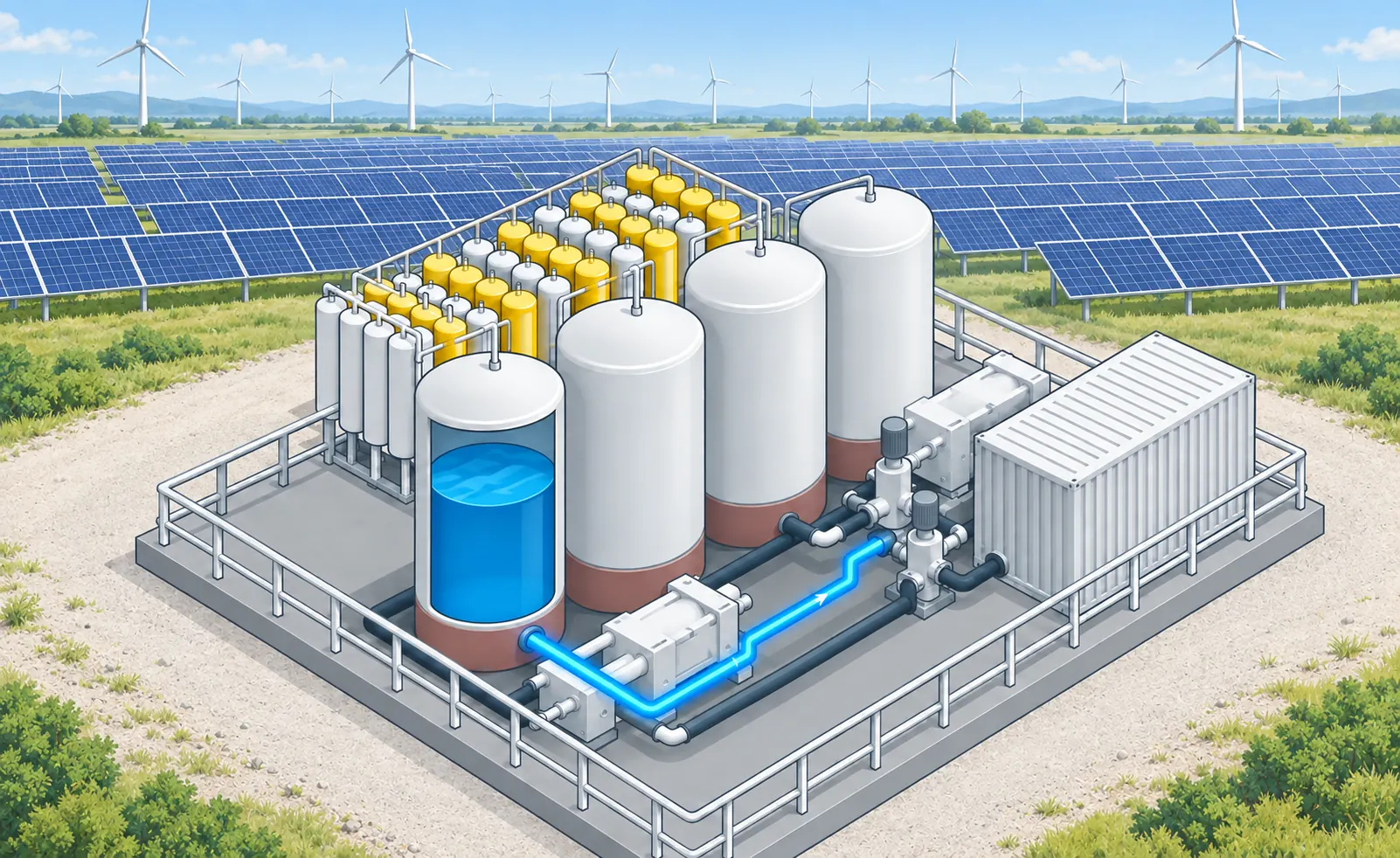
The liquid piston platform stores energy by compressing air, and releases it by expanding that air back through the same machinery to generate electricity. Compressed-air storage is not new; what is new is doing the compression near-isothermally — holding the air close to a constant temperature instead of letting it heat up fighting the heat-induced pressure.
Because both halves of the cycle are far more efficient, more of the electricity that goes in comes back out. That changes the economics of storing energy for days rather than hours. EIC calls this xLDES — eXtra Long Duration Energy Storage.
Why this is what makes duration possible
The efficiency gain is the headline, but the more important consequence is subtler. In a conventional adiabatic system, the heat of compression stays in the gas — and then leaks out of the storage vessel over hours and days, taking the stored energy with it. The longer you hold the charge, the less of it you get back.
That leaves two poor options: store the low-grade heat and reintroduce it later, which is difficult over long periods, or reheat by burning fuel, which defeats the purpose of storing renewable energy at all. How long you can usefully store energy ends up capped by how long you can hold onto heat.
Near-isothermal compression removes that cap, because the energy was never converted into heat for storing. It is the difference between a system that cycles daily and one that can carry a site through a still, overcast week.
Published work has demonstrated a 19% efficiency gain for liquid piston compression over traditional gas compression, with round-trip efficiencies reaching 70% — the full engineering case and references are here.
How it fits a plant
An EIC installation sits alongside generation, charging when output exceeds demand — the surplus that would otherwise be curtailed and wasted — and discharging when it does not. Air can be stored in purpose-built vessels or, for utility-scale duty, in subsurface reservoirs.
The platform integrates with commercially available Balance of Plant equipment, so a project does not require bespoke supporting infrastructure.
Why it matters to the grid
Storage sited at the right point on a congested network does more than shift energy in time — it defers transmission upgrades. Our modeling shows the platform can increase effective carrying capacity at congestion points by 50–75%, because power can be absorbed locally at peak generation and released locally at peak demand rather than pushed through constrained lines.
What this unlocks
- Firm renewable PPAs — sell round-the-clock clean power rather than variable output
- Higher capacity factors — monetize generation that would otherwise be curtailed
- Deferred transmission capex — relieve congestion without new lines
- Cost parity ambition — EIC’s target is firm green power at a cost competitive with natural gas generation
Resources
Written for engineers and developers evaluating this application. We ask who you are before sending the file.
- Download the PDF — Long Duration Energy Storage — EIC Isothermal Compressed Air Energy Storage, 2.9 MB
Long Duration Energy Storage — EIC Isothermal Compressed Air Energy Storage
The full I-CAES case: near-isothermal compression, the atmosphere as the thermal store, subsurface storage geology, and how the economics compare with lithium-ion.
PDF · 2.9 MB
Other applications
-
High pressure industrial gas compression
Cut the compression energy that makes banking of fuel gases expensive and space consuming. Cut downtime and maintenance costs. Maximize multiple energy source flexibility at data centers. Recover compression energy from stored gas and pipeline during letdown. Stop worrying about oil contamination.
-
HVAC & Refrigeration
Cut compression and cooling energy in food storage and data centers
-
CO₂ Capture & Liquefaction
Economically capture carbon from flue gas with as low as 15% CO₂. Valorize the offtake to cover capex. Compress and liquefy CO₂ economically and with less equipment risk.